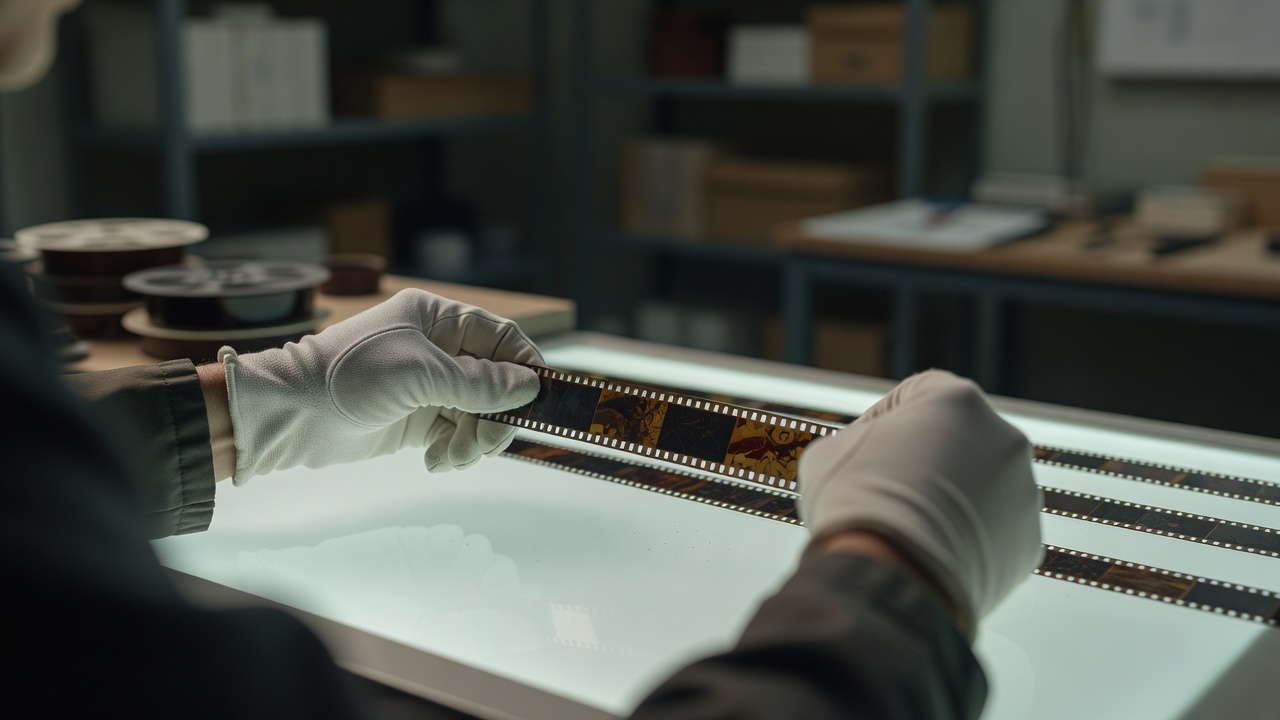
Cold, dry and dark
Film decays chemically, and chemistry slows in the cold. That simple principle drives modern film preservation. Nitrate and acetate both last far longer when stored at low temperature and low humidity, which is why the world's major archives invest in purpose-built vaults rather than ordinary shelving. The BFI National Archive, founded in 1935 as the National Film Library, opened its Master Film Store at Gaydon in Warwickshire in 2012 to hold its most vulnerable material in sub-zero, humidity-controlled conditions. The idea is not to stop decay, which is impossible, but to stretch it across centuries rather than decades.
Nitrate needs special treatment because of its fire risk. It is kept in small, separated vault cells designed to contain a fire should one start, and handled by staff trained for it.
The collectors who refused to let go
Much of what survives from early cinema exists because of individuals who kept prints when studios saw no value in them. In Paris, Henri Langlois co-founded the Cinémathèque française in 1936 with Georges Franju and others. Langlois collected obsessively and screened widely, and his programming shaped the young critics who became the French New Wave. When the French government tried to remove him in 1968, the protests from filmmakers were so loud that he was reinstated within weeks.
In Rochester, New York, the George Eastman Museum, in the former home of Kodak's founder, holds one of the oldest film collections in the United States. Its Dryden Theatre is equipped to project nitrate safely, and since 2015 it has hosted the Nitrate Picture Show, a festival devoted entirely to original nitrate prints.
In the United States, the National Film Preservation Act of 1988 created the National Film Registry at the Library of Congress, which adds twenty-five culturally, historically or aesthetically significant films each year. The Library's Packard Campus in Culpeper, Virginia, houses its moving image collections in vaults built into a hillside.
Restoration: deciding what the film looked like
Restoration is part science, part detective work. Technicians compare surviving elements, such as camera negatives, duplicate negatives and old release prints, to find the best source for each shot. Scratches, mould and shrinkage are treated, sometimes photochemically and increasingly through high-resolution scanning and digital repair. The hardest questions are aesthetic: what colour was that dress in 1954, and how much grain did the director intend? Labs such as L'Immagine Ritrovata, linked to the Cineteca di Bologna, have become known for this careful work, and Bologna's Il Cinema Ritrovato festival screens the results each summer.
Many restorations end up as digital cinema packages, but some archives and studios still strike new 35mm prints, both for preservation and for cinemas that want to show film as film.
Repertory screens: where prints still run
After the industry moved to digital projection in the early 2010s, most multiplex booths removed their film projectors. A smaller network of repertory cinemas kept theirs. In London, the Prince Charles Cinema near Leicester Square programmes 35mm and 70mm screenings alongside digital. In New York, Film Forum has long championed repertory programming and restored classics. In Los Angeles, the New Beverly Cinema, owned by Quentin Tarantino since 2007, became known for screening from film prints, many drawn from his own collection.
These cinemas depend on prints that archives and collectors are willing to lend, and on projectionists who still know how to inspect, splice and run them. Every screening adds a little wear, which is why lenders weigh each request carefully.
Seeing the room for yourself
Look at a repertory cinema's listings for the format of each screening; programmes often state "35mm" or "70mm" beside the title. Archives frequently run public screenings and open days too. Watching a print that has survived decades of handling is the best way to understand why all of this effort matters.