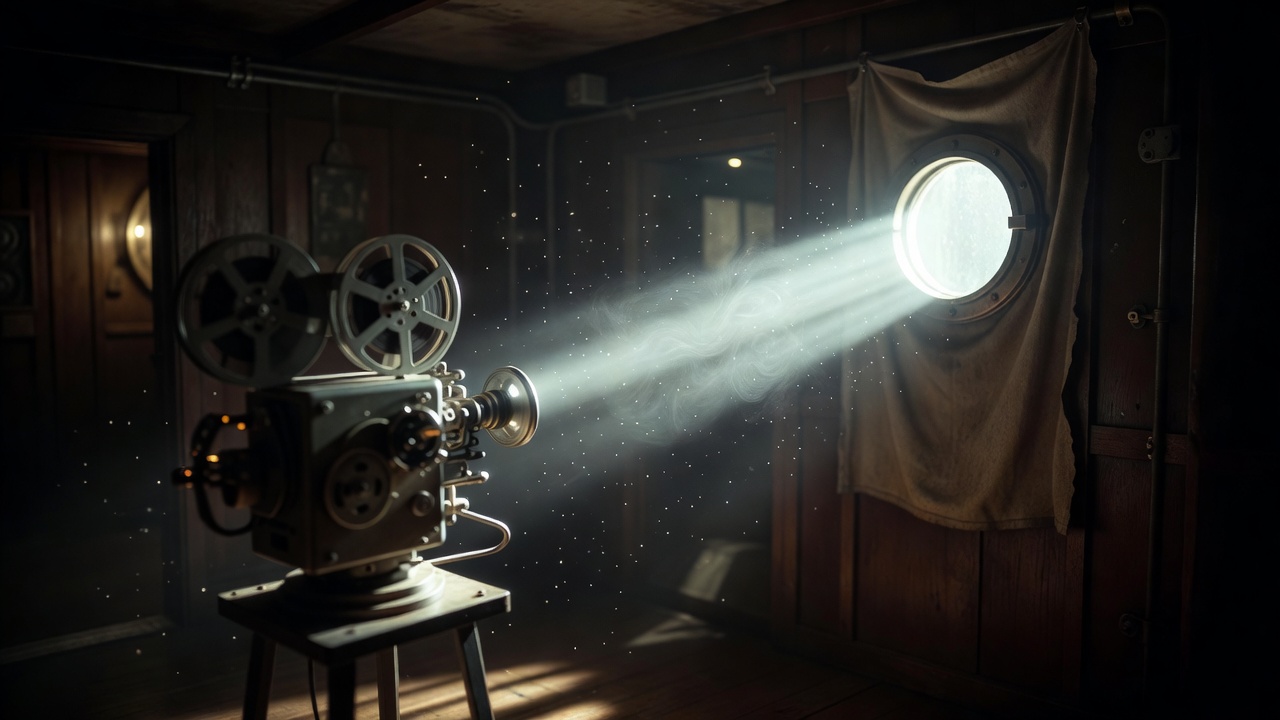
Why a film arrives in pieces
A feature film never travelled as one continuous roll. Prints were shipped to cinemas on a series of reels, typically around 2,000 feet each, which works out at roughly twenty-two minutes of screen time. Earlier practice used 1,000-foot reels of about eleven minutes, which is why older projectionists still speak of a film being so many "reels" long. A two-hour feature therefore arrived as five or six heavy reels packed into hexagonal shipping cases.
That raises the booth's central puzzle: how do you show a continuous film from separate pieces without the audience noticing? For decades the answer was two identical projectors standing side by side and a technique called the changeover.
The changeover, second by second
Reel one runs on projector A while reel two waits, threaded and dark, on projector B. Near the end of reel one, a small circle appears in the upper right corner of the image for a few frames. That is the first cue mark, the motor cue, placed about eight seconds, or twelve feet, before the end. The projectionist starts projector B's motor so it can reach speed. Seven seconds later a second circle appears, the changeover cue, one second before the end. Now the projectionist works the changeover, closing a shutter on A while opening B. Done well, the audience sees nothing but a continuous film.
Cue marks are why some prints show faint circles that appear and vanish in a blink. Once you know to look, you will spot them on old television broadcasts and home video transfers taken from release prints. Fight Club (1999) famously turned them into a plot point, calling them "cigarette burns".
Leaders: the countdown you were not meant to see
Every reel begins with a length of leader carrying a countdown so that it can be threaded at a precise point. The older Academy leader counted down from 11 to 3 in feet. The SMPTE Universal Leader, introduced later, uses a sweeping clock hand counting from 8 to 2 in seconds, often with a single beep at 2 to check sound sync. When a cinema threads a reel slightly late, you occasionally glimpse the last numbers flash by.
The platter: one projector, one long ribbon
From the 1970s, many cinemas, especially multiplexes, replaced changeovers with platter systems. The projectionist spliced all the reels together into one continuous ribbon laid flat on large horizontal discs stacked beside a single projector. Film fed from the centre of one platter, ran through the projector, and wound back onto another. A single operator could now run several screens at once, which changed staffing in booths everywhere. The splices, however, left their own small traces: a flash at each join, and cue marks that no longer served any purpose.
Light, shutter and flicker
Inside the projector, film stops dead in the gate for each frame, is lit, and is pulled down to the next by an intermittent movement, often a Geneva drive. A rotating shutter blocks the light during each pull-down. Most 35mm projectors use a two-blade shutter, flashing each frame twice, so twenty-four frames per second become forty-eight flashes per second, fast enough that most viewers stop seeing flicker.
The light itself changed over time. Early booths used carbon arcs, which burned down and needed constant adjustment. From the 1950s and 60s, xenon arc lamps took over, offering a steady, bright white source that could run for hours. Booth ventilation, once vital to clear carbon fumes, still mattered for xenon heat.
What to watch for in a screening
Next time you see a 35mm print, look for the cue marks near reel ends, a slight shift in colour or grain at a changeover where two reels were printed at different times, and the gentle, constant motion of grain that no two frames share. They are the fingerprints of the booth.