The base: three plastics, three eras
Every film is two things bonded together: a transparent base and a light-sensitive emulsion. The base is the part people rarely think about, yet it decides almost everything about a film's survival. From the 1890s until the early 1950s, professional 35mm film used cellulose nitrate. It was clear, strong and flexible, and it gave black-and-white images a deep, silvery glow that projectionists still talk about. It was also violently flammable. Nitrate burns hot, produces its own oxygen, and cannot be put out by smothering. Eastman Kodak stopped manufacturing nitrate base in 1951, and the industry moved over within a couple of years.
Its replacement, cellulose triacetate, was sold as "safety film", and the words were often printed along the edge so that anyone handling a reel could check at a glance. Safety film solved the fire problem but introduced a slow one: in warm, humid storage it releases acetic acid, the so-called vinegar syndrome. Open an affected can and the smell is unmistakable; the film shrinks, curls and eventually becomes brittle.
From the 1990s, release prints were increasingly struck on polyester base, sold by Kodak as Estar. Polyester barely degrades and is extraordinarily strong. Projectionists noticed one consequence immediately: where acetate would tear in a jam, polyester would hold, and something in the projector would give way instead.
The emulsion: where the picture lives
The emulsion is gelatin carrying silver halide crystals. In black-and-white film those crystals become the image directly. In colour stocks, several layers each respond to a different part of the spectrum and form dye clouds during processing, after which the silver is removed. Look closely at a colour negative and you see the inverse: an orange-tinted mask and colours flipped to their complements.
Before modern multilayer stocks, the most famous colour came from Technicolor. Its three-strip camera split light onto three separate black-and-white negatives, and prints were made by dye transfer, pressing each colour onto the film like printing ink. Becky Sharp (1935) was the first feature shot entirely in the three-strip process. Dye transfer prints are prized today because their colours resist fading far better than many chromogenic prints from the 1970s, which often drifted toward magenta.
The geometry: perforations and frames
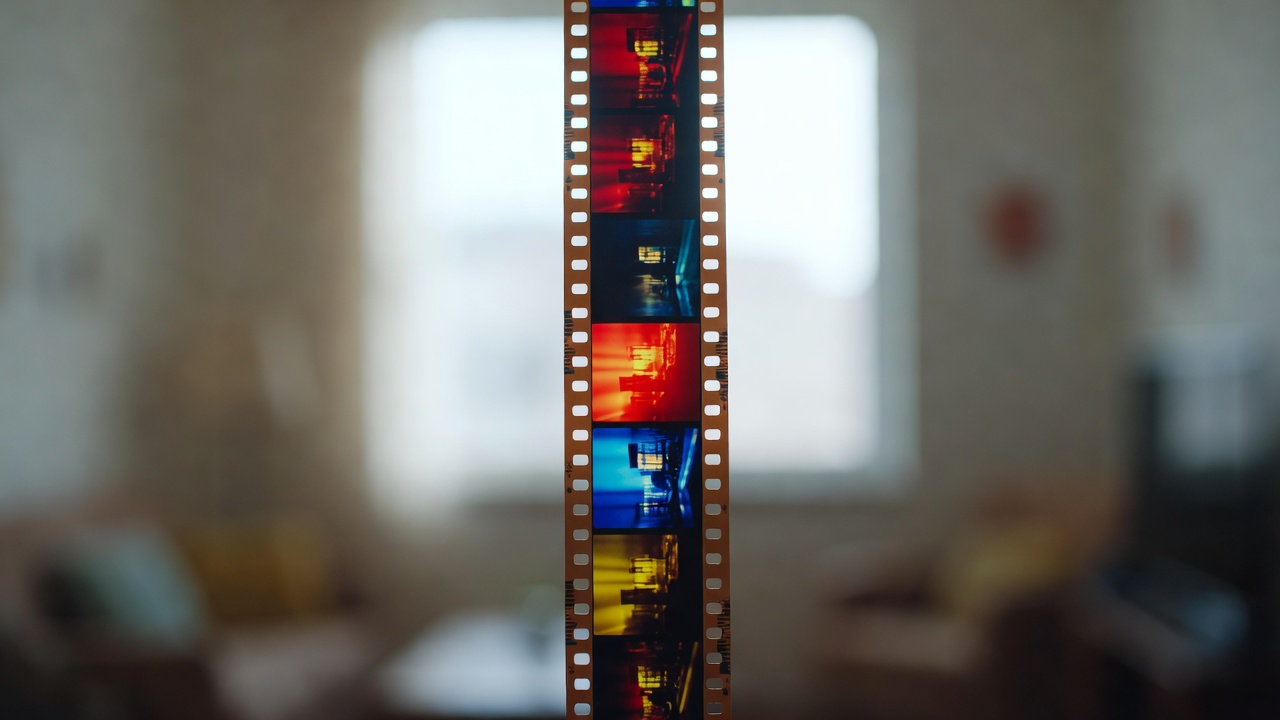
The numbers on a 35mm strip are worth memorising, because so much follows from them. Each frame spans four perforations on each side. Sixteen frames fill one foot. At the sound-era standard of twenty-four frames per second, film travels ninety feet every minute, so a two-hour feature runs to roughly 10,800 feet, about two miles. Larger formats change the arithmetic: standard 70mm uses five perforations per frame, while IMAX runs 70mm sideways at fifteen perforations per frame. Christopher Nolan's Oppenheimer (2023) circulated in 70mm IMAX prints reported to run about eleven miles each.
Frame shape matters too. The Academy ratio of 1.37:1, standardised in the early sound era, left room for an optical soundtrack beside the picture. Widescreen processes later masked or squeezed the image to fill wider screens.
The margins: sound and codes
The thin wavy band beside the frames is the analogue optical soundtrack, read by a light and a photocell. It sits ahead of its matching picture, 21 frames on 35mm, because the sound reader is placed below the gate. In the 1990s, three digital formats squeezed in alongside: Dolby Digital blocks printed between the perforations, SDDS data along the outer edges, and a DTS timecode track that synchronised a separate disc. A single print could carry all four.
Finally, the edge codes. Camera negative such as Kodak's Vision3 500T 5219 carries tiny latent numbers and machine-readable barcodes along its edge, identifying the stock and counting footage. Editors used them to match a work print back to exact original frames. To a curious viewer they are a signature: proof of which stock, which batch, which moment.